
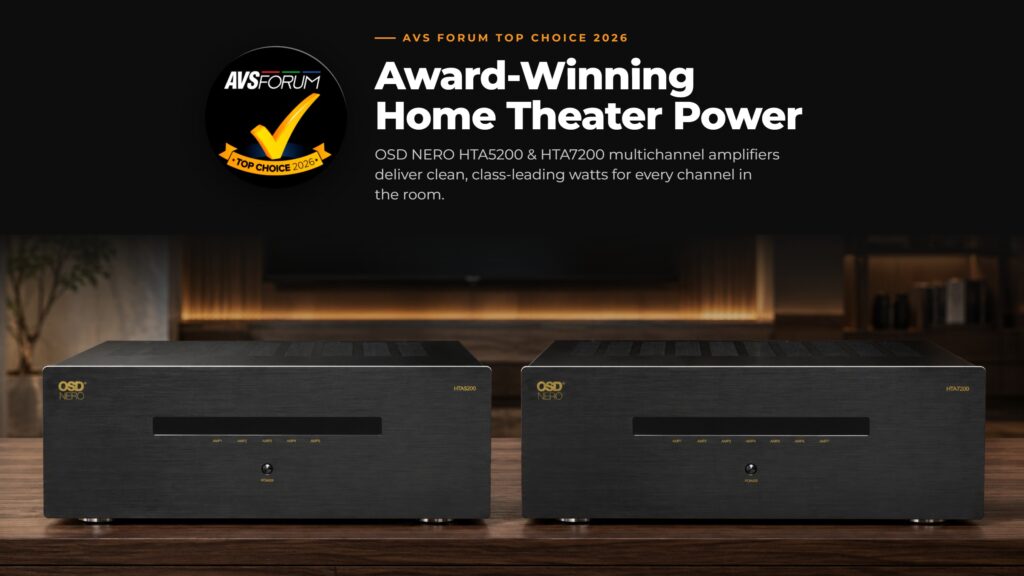
Two Amplifiers, Two Top Choice Awards
AVS Forum has published a full review of the OSD Nero HTA5200 and HTA7200 home theater amplifiers, and both models came away with an AVSForum Top Choice Award for 2026. The review is titled “Turn the Volume Up on Value,” and after reading it, the title fits.
This is the second time this year that a Nero amplifier has landed in front of the AVS Forum audience. The same reviewer previously spent time with our flagship XMAX11, the 11-channel Class AB amplifier at the top of the Nero line, then wanted to see what the rest of the family could deliver at a considerably lower price. The HTA5200 and HTA7200 were the answer.
Read the full review on AVS Forum
Tested as a Full 11-Channel Atmos System
What makes this review worth reading is how the amplifiers were put to work. Rather than evaluating them one at a time, the reviewer ran both together to build a complete 11-channel Dolby Atmos system: the HTA7200 driving the seven-channel bed layer, and the HTA5200 handling four overhead height channels. Both were fed by balanced XLR connections from a Marantz AV30 processor.
Speaker duties went to a MartinLogan system, with Motion XT F200 towers up front, an XT C100 center, four Motion MP10 speakers covering surrounds and rears, and four Motion CI MC8 in-ceiling speakers overhead. A pair of Klipsch RF-7 III towers was also brought in during testing to see how the amplifiers behaved with a far more sensitive load.
Power Ratings You Can Actually Use
The review picked up on a point that sits at the center of how we spec the HTA series. Both amplifiers are rated at 145 watts per channel into 8 ohms and 210 watts per channel into 4 ohms with every channel driven. A great many amplifier specifications are measured with only two channels active, which does not reflect what happens during an actual movie soundtrack.
Backing that up: both models carry four 10,000µF capacitors for current reserve, with dual toroidal transformers sized to the channel count. The HTA5200 uses 1,075VA transformers and draws up to 13.6 amps across all channels. The HTA7200 steps up to 1,505VA and 19 amps to feed its two additional channels.
Both are specified at 110 dB signal-to-noise at rated power, 105 dB at 1 watt, with distortion held below 0.01% at 105 dB output. That last figure is the one that matters most in a theater, because 105 dB is the reference peak level commercial cinemas are designed around. Hitting it cleanly, across every channel at once, is the real engineering problem.
A Quiet Starting Point
Before getting to dynamics, the review looked at something we care a lot about: how quiet an amplifier is when nothing is happening. Big power figures do not mean much if there is audible hiss during a quiet scene.
Both Nero amplifiers stayed quiet in the reviewer’s system. The high-sensitivity Klipsch RF-7 III revealed a slight amount of noise, which the review notes is typical behavior for efficient speakers rather than a shortcoming of the amplifier. The overall assessment was that both models performed very well here.
Where the Headroom Shows Up
Performance testing leaned on scenes built to expose an amplifier running out of room. The Batmobile chase from The Batman, which opens quietly before erupting into chaos, was described as holding its tension and then delivering the engine roar, screeching tires, and closing explosions with real impact, with no sense of the amplifiers running out of steam at the loudest moments. The overhead channels stayed integrated with the rest of the soundstage rather than feeling like a separate layer.
The final battle in Tenet and Furiosa’s escape from the Citadel in Mad Max: Fury Road pushed things further, with layered gunfire, explosions, and constant object movement across all eleven channels at once. In both cases the review found the amplifiers kept the soundstage clean and the individual layers separated as the scenes continued to build.
One practical note from the review: after running those scenes back to back, both amplifiers were quite warm. These are air-cooled Class AB designs, so plan your rack accordingly and give them room to breathe.
“OSD has created two amplifiers that are very easy to recommend”
Erik Wesley, AVS Forum
Build Quality and Connectivity
The review called build quality excellent and noted the weight immediately: 71 pounds for the HTA7200 and 63 pounds for the HTA5200. Both share the same chassis at 6.3 inches high, 17.1 inches wide, and 16.57 inches deep, and both are rack-mountable.
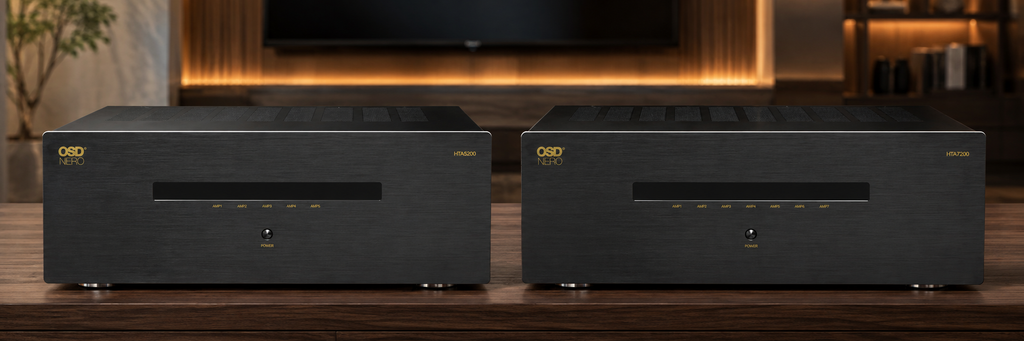
Compared to the XMAX11, the front panel takes a more restrained approach. There is no VU meter, but the status indicators remain: individual LEDs for every channel, seven on the HTA7200 and five on the HTA5200, plus power, standby, and protection indicators. The finish is black brushed metal with gold accent lettering for the Nero branding and model numbers.
Around back, every channel gets both balanced XLR and unbalanced RCA input, so the amplifier adapts to whatever processor or receiver you are running. Speaker connections use gold-plated binding posts that accept bare wire up to 12 AWG, pin connectors, spade lugs, or single banana plugs. Both models include a 3.5mm 12-volt trigger input and output, a main power switch, selectable 120V or 240V operation, and a detachable six-foot power cord.
HTA5200 vs. HTA7200
| Audio Performance | ||
|---|---|---|
| Nero HTA5200 | Nero HTA7200 | |
| Channels | 5 | 7 |
| Amplifier Class | Class AB | Class AB |
| Output, 8Ω, all channels driven | 145W per channel | 145W per channel |
| Output, 4Ω, all channels driven | 210W per channel | 210W per channel |
| Total Harmonic Distortion | <0.01% at 105 dB | <0.01% at 105 dB |
| Signal-to-Noise Ratio | 110 dB at rated power, 105 dB at 1W | 110 dB at rated power, 105 dB at 1W |
| Power Supply | ||
| Transformers | Dual toroidal, 1,075VA | Dual toroidal, 1,505VA |
| Capacitors | Four 10,000µF | Four 10,000µF |
| Maximum Current Draw | 13.6 amps | 19 amps |
| Voltage | 120V / 240V selectable | 120V / 240V selectable |
| Cooling | Air cooled | Air cooled |
| Connectivity & Controls | ||
| Balanced Inputs | XLR, every channel | XLR, every channel |
| Unbalanced Inputs | RCA, every channel | RCA, every channel |
| Speaker Terminals | Gold-plated binding posts, up to 12 AWG | Gold-plated binding posts, up to 12 AWG |
| Trigger | 3.5mm 12V input and output | 3.5mm 12V input and output |
| Status Indicators | 5 channel LEDs, power, standby, protection | 7 channel LEDs, power, standby, protection |
| Power Cord | Detachable, 6 ft | Detachable, 6 ft |
| Cabinet & Build | ||
| Front Panel | Black brushed metal, gold accents | Black brushed metal, gold accents |
| Dimensions | 6.3″ H x 17.1″ W x 16.57″ D | 6.3″ H x 17.1″ W x 16.57″ D |
| Weight | 63 lbs | 71 lbs |
| Rack Mountable | Yes | Yes |
| Price | $899 | $1,099 |
Which One Fits Your Room?
Per-channel performance is identical between the two, so the decision comes down to channel count and how you plan to grow. A 5.1 or 5.2 room is well served by the HTA5200. A 7.1 or 5.1.2 layout wants the HTA7200. And as this review demonstrates, running the two together gets you a full 11-channel Atmos system with headroom to spare.
The review closed by calling both amplifiers easy to recommend, pointing to dynamics and consistency that held up with multiple channels working hard. The listed strengths were clear channel status indicators, overall performance, and dynamic headroom. The one listed drawback was the size and weight of the chassis, which is hard to argue with at 63 and 71 pounds.
We are grateful to AVS Forum for the time and for the awards. If you are shopping in this category, read the thread in full, including the community discussion that follows it. Independent impressions from people running real systems in real rooms carry more weight than any spec sheet, including ours.
AVS Forum reviewed both amplifiers in a full 11-channel Dolby Atmos system and named each one an AVSForum Top Choice for 2026. The review highlighted clear channel status indicators, excellent overall performance, and dynamic headroom, with the size and weight of the chassis noted as the main drawback.
Channel count. The HTA5200 has five channels and the HTA7200 has seven. Per-channel power is identical at 145 watts into 8 ohms and 210 watts into 4 ohms with all channels driven. The HTA7200 uses larger 1,505VA transformers to support the two extra channels, compared to 1,075VA in the HTA5200.
Yes. Both amplifiers are rated at 145 watts per channel into 8 ohms and 210 watts per channel into 4 ohms with every channel driven simultaneously, not with only two channels active as many specifications are measured.
Yes, and that is exactly how AVS Forum tested them. The HTA7200 powered the seven-channel bed layer while the HTA5200 handled four overhead height channels, creating a complete 11-channel Dolby Atmos system. The 12-volt trigger output on either amplifier can link to the other for coordinated power on and off.
Plan for it. Both are air-cooled Class AB designs, and the review noted that both ran quite warm after demanding scenes played back to back. Leave clearance around the chassis and allow airflow through your rack.
Read the AVS Forum review and Top Choice Award
Shop the OSD Nero HTA5200
Shop the OSD Nero HTA7200
Browse all OSD home theater amplifiers
Not sure which amplifier fits your speakers or your room? Reach out before you buy and our team will walk you through it.